Method pages
Complib acts as a method collection, and has dedicated pages for all methods in its libraries, including every method officially named and rung. The official CCCBR library is regularly updated and newly named methods added in order to keep the collection up to date.
When a new method is added to any of its libraries, Complib classifies it and derives its various properties. It then creates a page for the method where its related information can be viewed. For example, the method page for Bristol Surprise Major looks something like this:
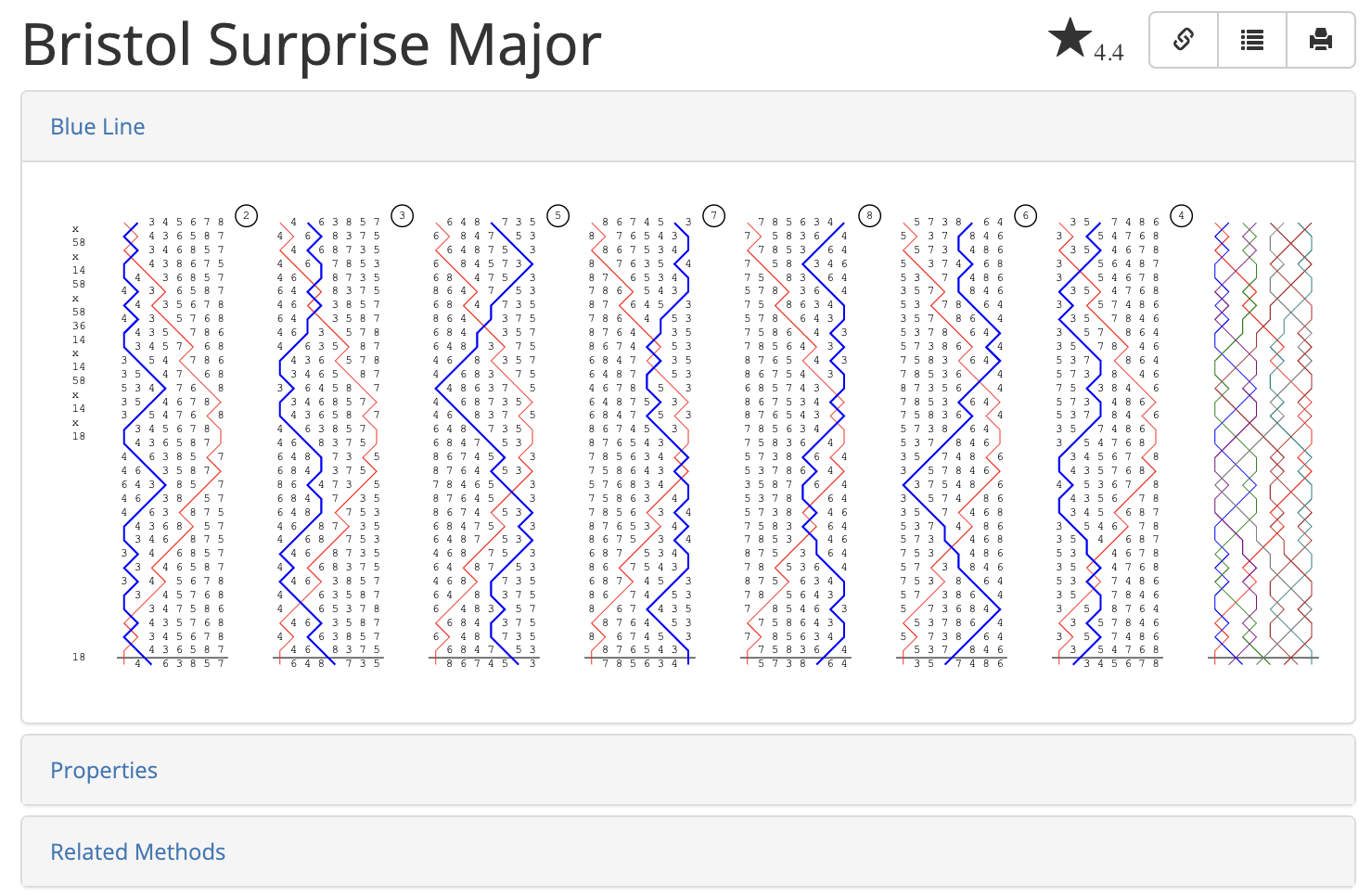
The method's title is displayed at the top. If this title has changed since the method was first rung, the previous title(s) will be displayed underneath the current title if they are known.
Toolbar
To the side of the method's title is the toolbar:

The toolbar buttons can be identified by hovering over them. Some of the toolbar buttons may not be visible on every method page, or to every user. The buttons are, from left to right:
 Find compositions true to this
- Begins an extended search of compositions in the Composition Library to determine which ones can be rung with this method (see Extended searches). The search will include any private compositions you have defined. Only available to registered Power Users.
 Add to collection
- Adds the method to a collection of your choice (see Collections). Only available to registered users.
 Design new (unrung) methods like this
- Opens the method designer with a new blank method skeleton. The method skeleton will have the same hunt bell path as the method currently being viewed (see Using the method designer). Only available to registered users.
 Clone
Clone- Creates a duplicate of the method on the Add method page which you can then edit (see Adding methods). Only available to registered Power users.
 Edit
Edit- Opens the method in the method editor. Only available registered users when viewing a private method which you own.
 Share
Share- Displays a public link to the method page so it can be shared with others. For information on what it means for a method to be public, see Adding methods > Private and public methods.
 Export rows
- Opens a new browser tab displaying all the rows of the method's plain course in plaintext format.
 Printable version
- Opens a new browser tab displaying the contents of the blue line tab in a form which may be easier to print.
Tabs overview
A method page is subdivided into various expandable tabs (click on the name of a tab to skip to a detailed description of its contents):
- Blue Line
- A visual representation of the method.
- Properties
- The structural properties of the method, including its place notation, leadhead group, extension path (if applicable) and more. A large amount of this information relates to the method's classification, which derives from the Central Council's Framework for Method Ringing.
- Hunt Bell Path(s)
-
The features and properties of the paths of the hunt bell(s), if any.
Will only be visible if Show hunt bell properties in method view and search is enabled on your user profile page.
- Related Methods
- Any methods which are related to the current method, such as halflead/leadend variants and methods belonging to the same extension family (whether compliant with the Central Council Framework or not).
- Trivial Variations
- Any methods which are considered to be trivial variations of the current method.
- Performances
- Historical information about occasions when the method has been performed, including when it was first rung and named and any recognised record lengths, with links to the relevant Bellboard performance (if provided).
- References
- A list of all accessible collections containing the method. If you own a private collection containing the method, it will be listed here.
- Library Details
- The method's Complib-specific metadata including which library it is contained within, the corresponding method ID, and its dates of creation, publication, etc.
Blue line
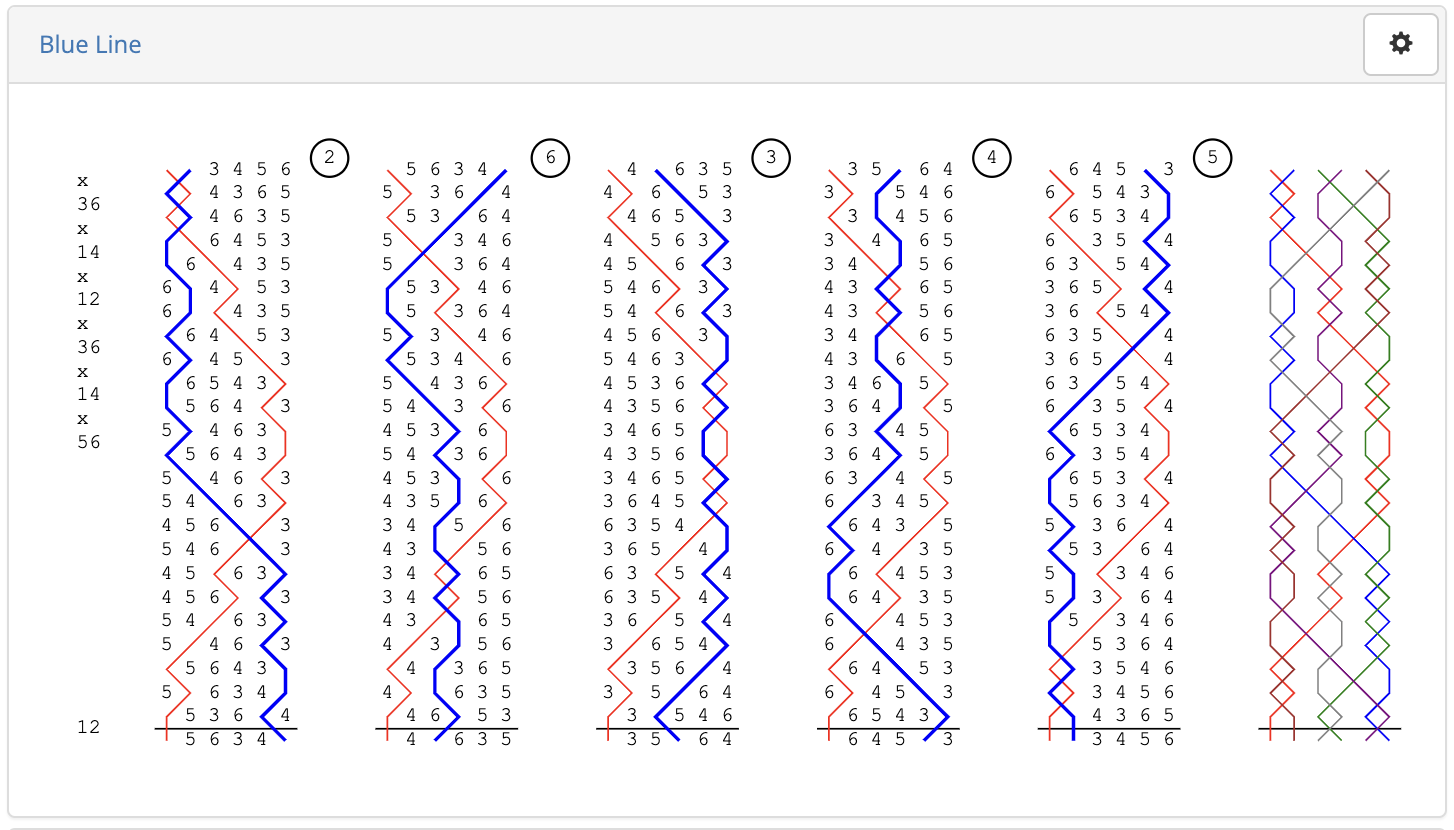 This tab renders a visual representation of the method. By default, this is done in the traditional Diagrams style with all hunt bells plus a single working bell drawn in coloured lines. The method's grid, which consists of a single lead/division with all bells drawn in coloured lines, is also shown by default.
The appearance of the blue line display is highly customisable. For more information about how to adjust the display style, see Customising the blue line.
Note
You need to be logged in as a registered user to adjust the Blue Line display style.
Properties
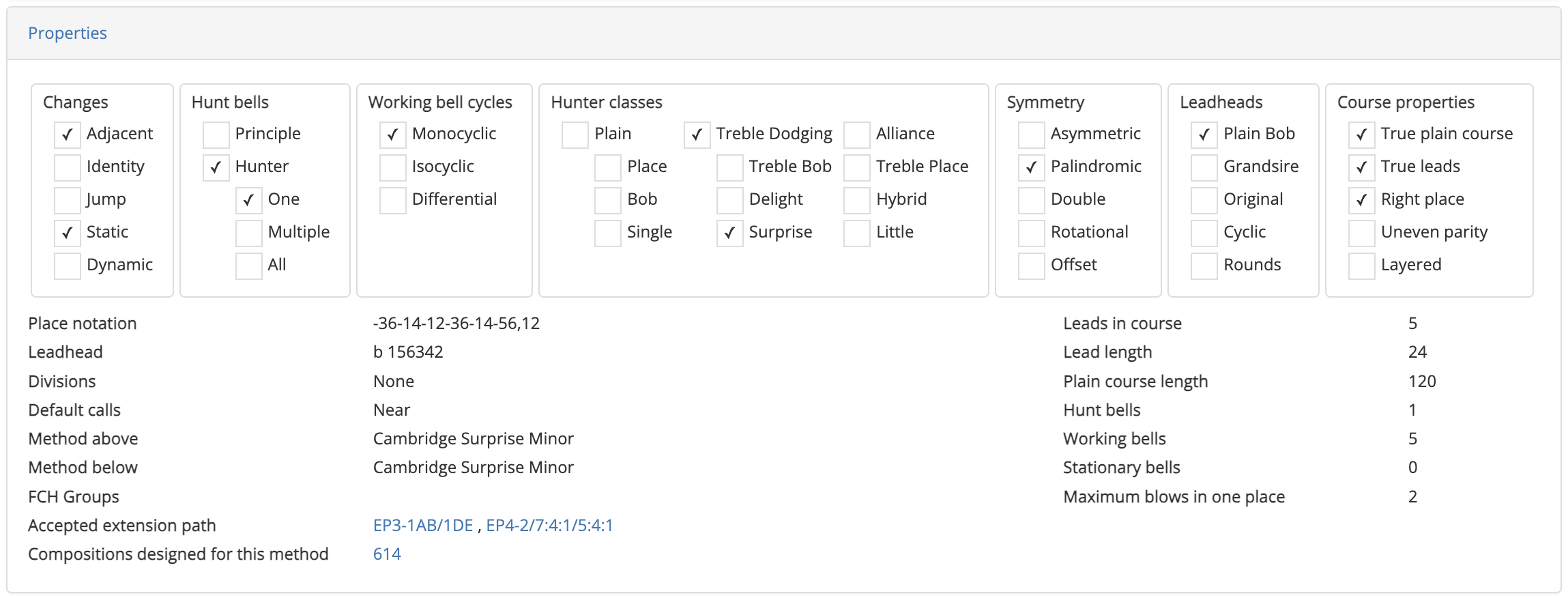
See the page on Method properties for an explanation of the information in this tab.
Hunt bell path(s)
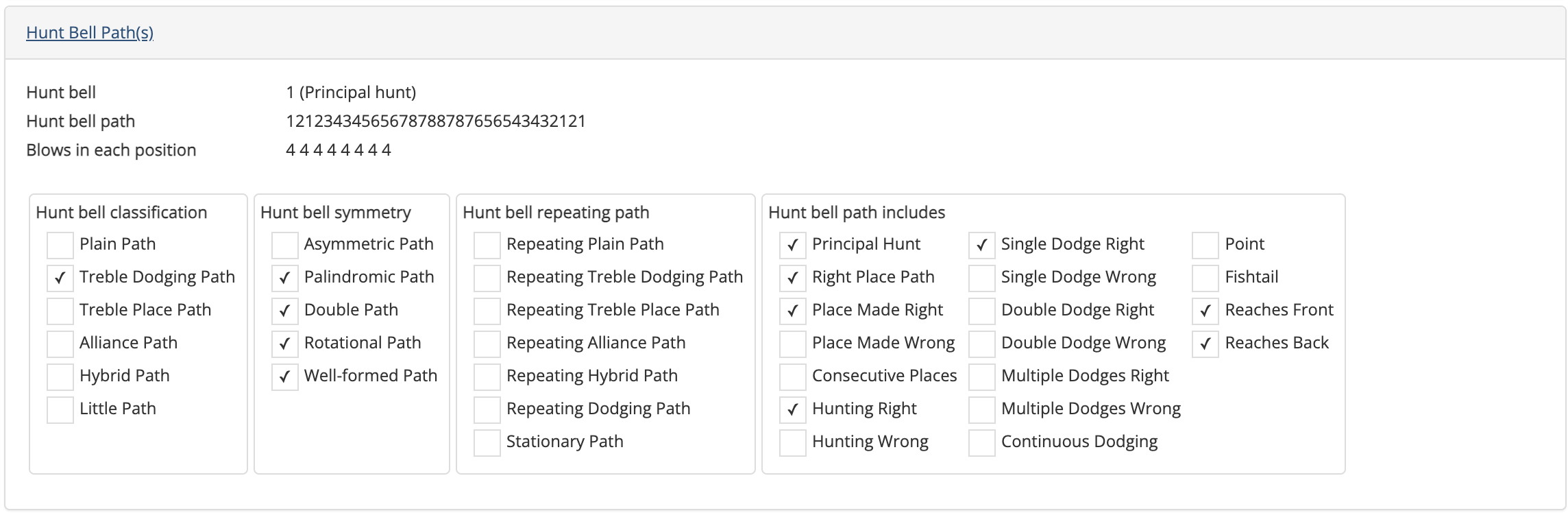
See Advanced > Hunt bell properties for an explanation of the information in this tab.
Related methods
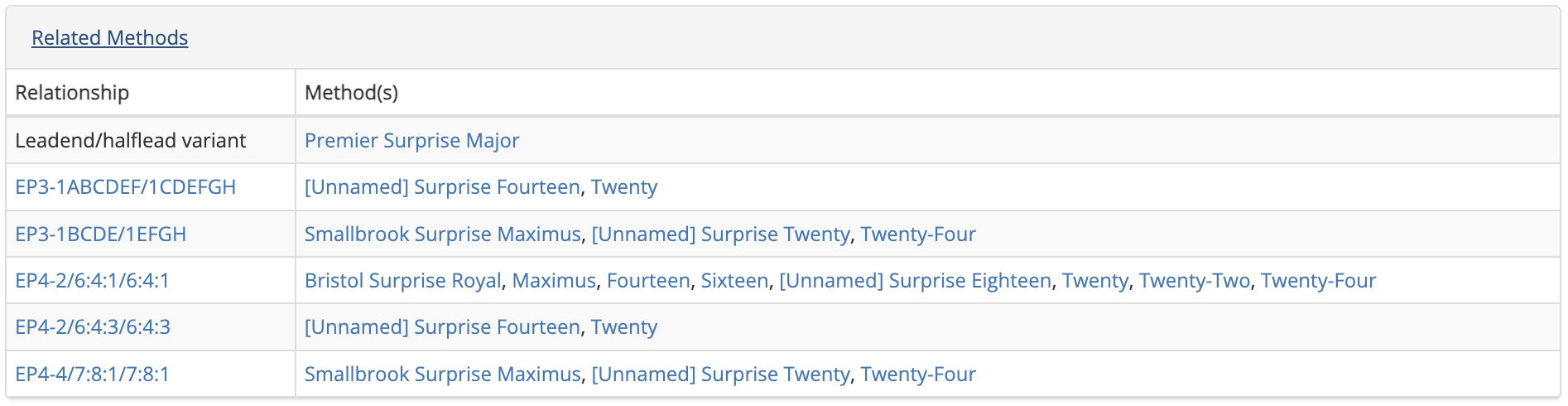
Methods may be related to other methods in a number of different ways. Methods which are related to the current method in any of the following ways will be listed in this tab.
- Halflead/leadend variants
-
A halflead/leadend variant of a method is any method which differs from it only by which change is made at the halflead/leadend. For example, Cambridge Surprise Minor and Primrose Surprise Minor are leadend variants.
Hovering over the name of a halflead/leadend variant will indicate the way in which its halflead (HL) and/or leadend (LE) differs from the current method.
- Reverse
- The reverse of a method is the method obtained by reversing all its rows. Equivalently, it is the method obtained by inverting the method's place notation (see Place notation).
- Double work above/below
- For methods with a single hunt bell, the combination of the work done above/below the hunt bell with an inverted copy of itself will give a double method, which may or may not have been named.
- Extensions
- Two methods at different stages are extensions of one another if they are related by any of the recognised extension paths. If the method can be extended using any of the recognised extension paths, methods in the path will be listed up to stage Twenty-Four (see Extensions).
- Non-conforming extensions
-
If two methods share the same name and class but are not related by any of the recognised extension paths, then they are non-conforming extensions of one another. A previously non-conforming extension may become a conforming extension in the event that:
- a new extension pathway becomes recognised; and
- the previously non-conforming extension can be obtained by application of that new pathway.
Note
There are a number of reasons why a method may be listed on Complib as a non-conforming extension. These include (but are not limited to):
- The method (or another method related to it) was named and rung before the formal framework of method extension was developed, or before computer analysis was available to aid in spotting naming conflicts.
- The method is non-palindromic. No systematic framework for extending non-palindromic methods yet exists (although Complib can currently handle a limited number of cases).
Method classification and extension is still a field of active development, and over the centuries it has reflected changing values within the Exercise. For the most part, there is a general agreement that more rigorous modern practices should be balanced with the preservation of ringing history.
Trivial variations
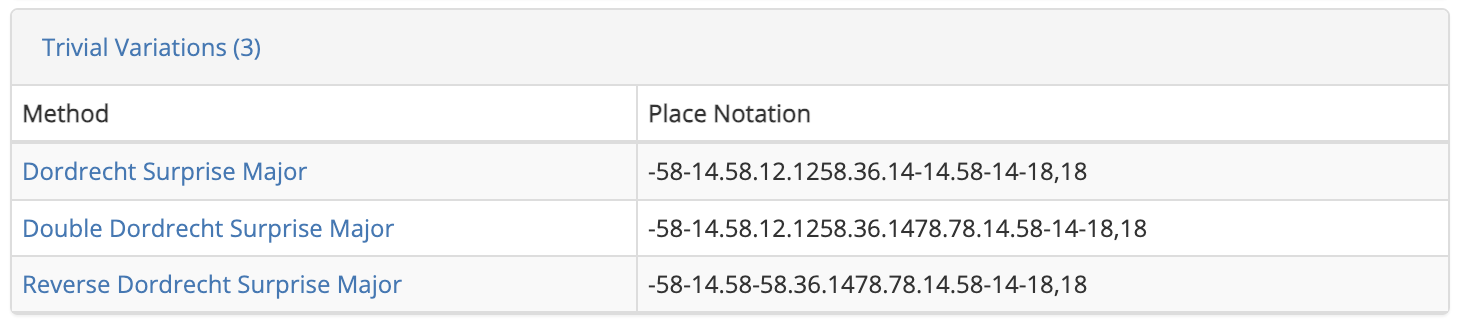 This tab lists all named methods which are related to the current method by means of a trivial variation, together with their place notations. Trivial variations are ways of slightly altering the blue line of a method without changing its overall structure.
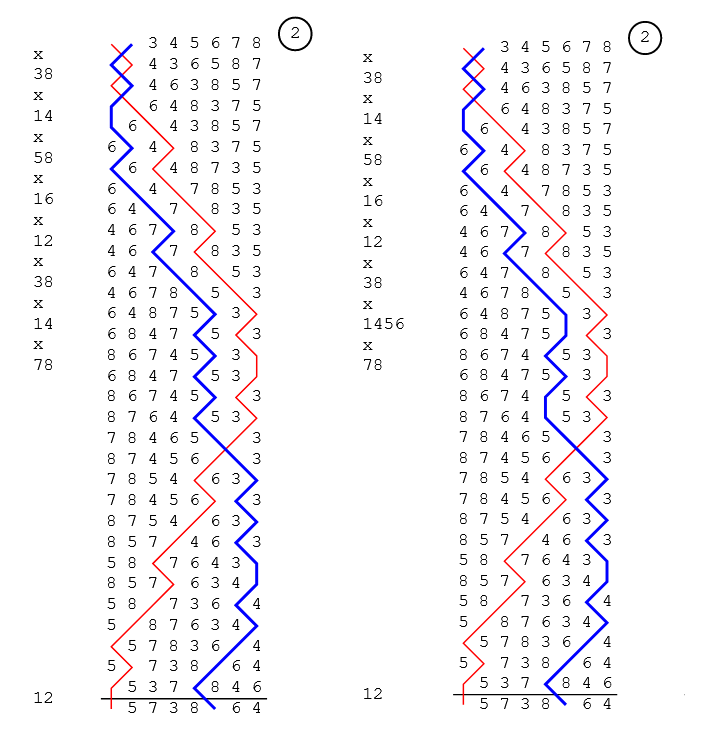
The image above shows the first leads of Yorkshire Surprise Major (left) and Quedgeley Surprise Major (right), which are trivial variations of each other. It can be seen by inspection that the two are almost identical, with only slight differences in the blue line.
A method is a trivial variation of another method if the path of each bell in one method deviates no more than one place away from an equivalent path in the other. Equivalent path does not necessarily mean the same bell: Reverse Canterbury Pleasure Place Doubles and Plain Bob Doubles are trivial variants, but only when considering the paths of bells 3 and 4 to be equivalent.
The property of trivial variation as defined here is a symmetric relationship: if method B is a trivial variation of method A, then method A is necessarily a trivial variation of method B. However, it is not a transitive property: if C is another trivial variation of A, it does not necessarily follow that C is also a trivial variation of B.
Warning
A method might differ from its trivial variants in decidedly non-trivial ways. Their plain courses may not have the same rows, and they may have different false coursehead groups.
Because of this, a composition which is true to one method is not necessarily true to all (or indeed any) of that method's trivial variations. You should always check a composition is true to the specific method you wish to ring.
Performances
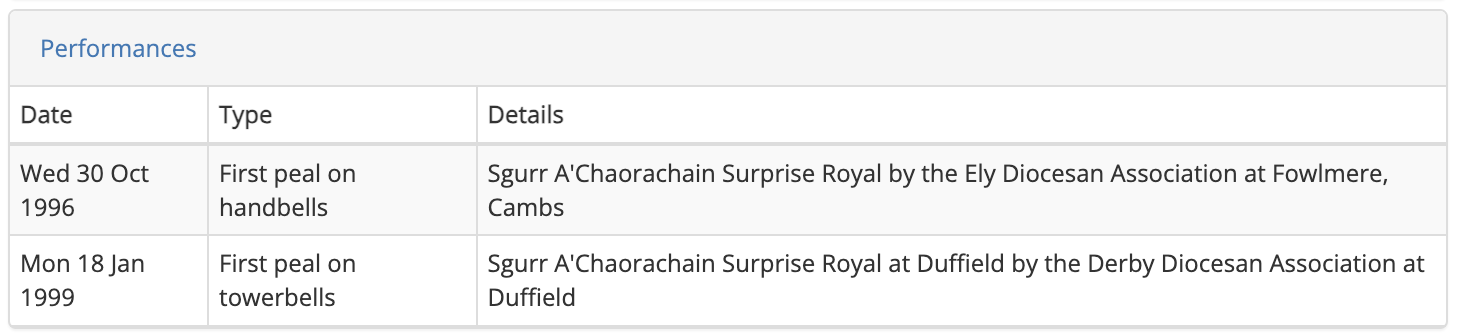
This tab lists any documented performances of the method which have been added to its Complib page. Each entry has three fields:
- Date
- The date on which the performance was rung.
- Type
-
Specifies one of a number of different performance types:
- First inclusion in a peal/quarter peal/etc.: a multi-method performance where the method is recognised to have been rung for the first time.
- First peal/quarter peal/etc.: a single-method performance where the method is recognised to have been rung for the first time (or, for methods previously rung in a multi-method performance, the first time it was rung by itself).
- First extent: for methods at stages Minor and below, a performance containing an extent of the method at that stage where the method is recognised to have been rung for the first time.
- Long Length: a performance of 10,000 changes or more.
Performances are further typified by their Ringing Style:
- Towerbell: a traditional performance on towerbells using ropes and wheels;
- Handbell: a double-handed performance on handbells, either with real handbells or with an electronic substitute;
- Keyboard: a performance in which bell sounds are achieved by pressing a keyboard, either analogue (e.g. a carillon) or digital (e.g. a computer keyboard);
- Other: a performance which does not fit into any of the above categories, such as tapped performances;
- Mixed: a performance in which a mixture of the above are used.
For more about Ringing Styles and how performances are reported, see Section 6 of the Central Council Framework for Method Ringing.
- Details
- The published details of the performance: title, performing Guild or Association (if given), location, and conductor (if given).
Note
There is an order of priority within performance types, which broadly corresponds with length. The priority order is, from highest to lowest:
- Long length
- First peal
- First inclusion in a peal
- First quarter peal
- First inclusion in a quarter peal
- First extent
A performance is typically only included if no performance of that length or greater has been recorded prior to that date. Once a performance of greater length has been recorded, shorter performances from after that date will no longer be added (but will be retained if added previously). The exception to this is long lengths, which will always be recorded.
References
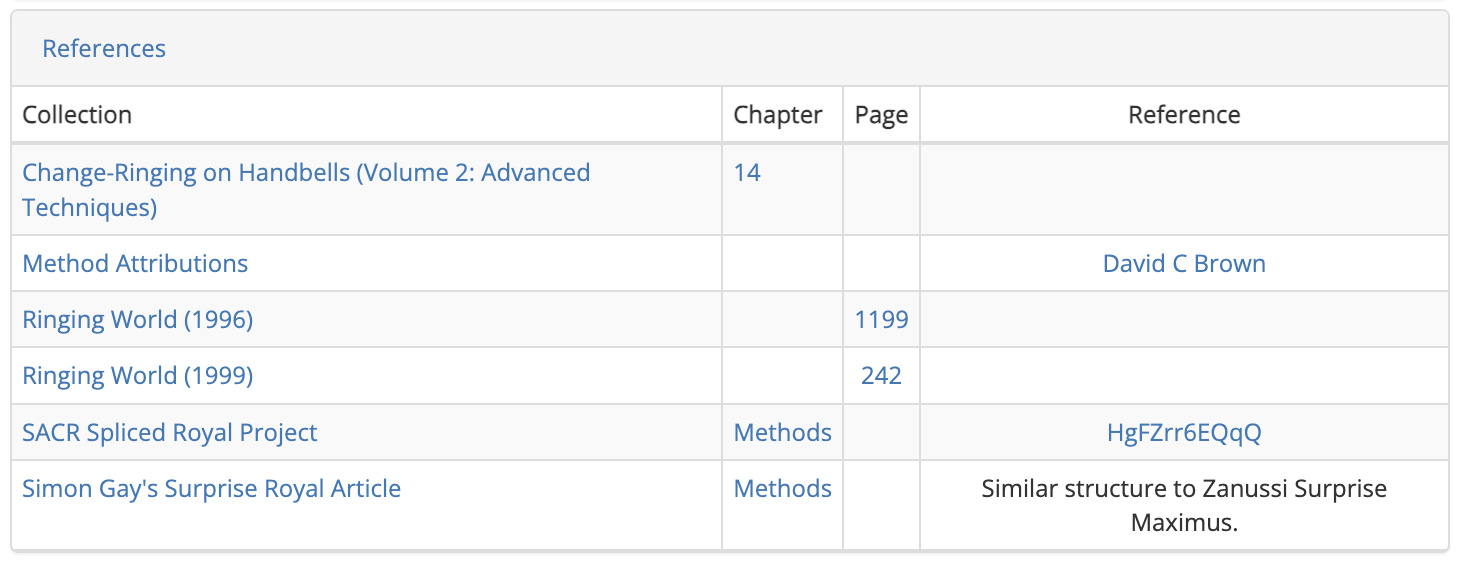
This tab lists all collections which you have access to and which reference the current method (inaccessible private collections will not be displayed). Each entry has four fields, with most entries acting as links to external references or to other pages in the Composition Library:
- Collection
- The name of the collection to which the method belongs.
- Chapter
- The chapter of the method's entry in the collection (if specified).
- Page
- The page number of the method's entry in an external reference (if specified).
- Reference
- In the case that the collection links the method to an internal or external reference, or provides a text description, that reference will be given here.
For more on references and how they relate to collections, see Collections.
Library details
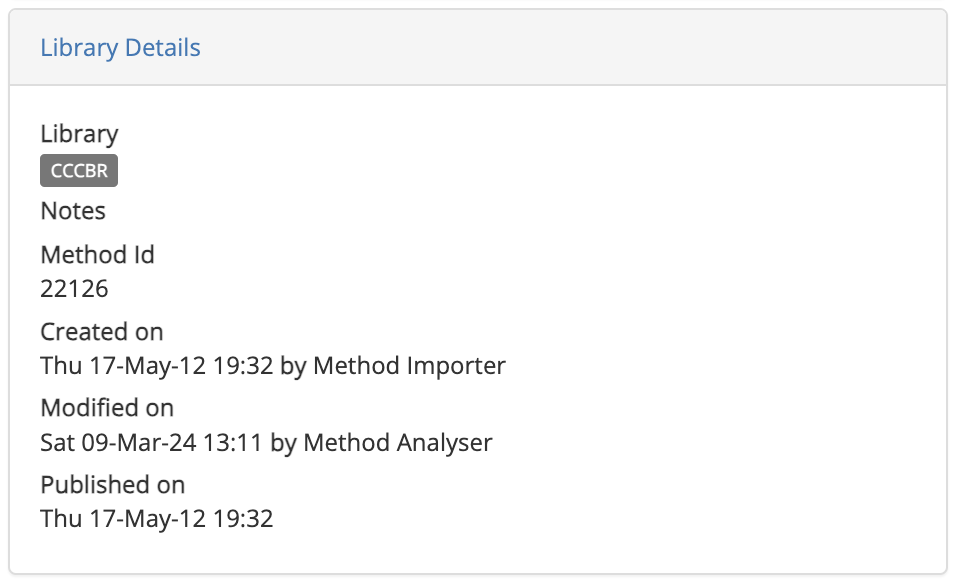
This tab lists some of the method's Complib-specific metadata.
- Library
- The library which contains the method.
- Notes
- Any notes provided by the method's publisher (see Adding methods).
- Method Id
- The method's numerical ID. This is the number featured at the end of a method page's URL. It is also recorded in the CCCBR's methods library as an immutable identifier.
- Created on
- The date and time at which the method was created and the name of the user who created it.
- Modified on
- The date and time at which the method was last modified and the name of the user who modified it.
- Published on
- The date and time at which the method was made public.
Note
Times and dates are given in your Local Time.